
Originally posted by Sister Mary Maria
View Post
-
Re: If we came from monkeys, why don't we have tails?
I just wanted to say that for a woman you have a very good head for science and a very logical mind. -
Re: If we came from monkeys, why don't we have tails?
Originally posted by Bogdana Alkeav View Post
Oh, I am disappointed.Originally posted by Schopenhauer View Post
That is what is in the Wikipedia article. (Don’t use the German version, it is very short and contains no detail)
In the hope of bringing more souls to Jesus, this writing is not much use. All atheists say that it is a forgery and that Josephus never wrote such a thing. This leaves us Christians looking like fools for relying on a book other than the Bible.
I was hoping that you had some writings that really spoke of Jesus. I have always been disappointed that there seemed to be no one around at the time who was recording Jesus’s miracles, Resurrection, etc.
You would have thought that God’s Son would have left a little more behind, wouldn’t you? But this is consistent with everything Jesus said – it is more important to have Faith than proof of every little detail.
Leave a comment:
-
Re: If we came from monkeys, why don't we have tails?
Hmm, so I guess you don't actually have anything to back up your claims about detailed Roman execution records or a lot of letters being written by Jews?Originally posted by Schopenhauer View Post
Now, about the Josephus stuff-
Josephus and Jesus
The Jewish historian Flavius Josephus, writing during the second half of the first century CE, produced two major works: History of the Jewish War and Antiquities of the Jews. Two apparent references to Jesus occur in the second of these works. The longer, and more famous passage, occurs in Book 18 of Antiquities and reads as follows (taken from the standard accepted Greek text of Antiquities 18:63-64 by L. H. Feldman in the Loeb Classical Library):About this time there lived Jesus, a wise man, if indeed one ought to call him a man. For he was one who wrought surprising feats and as a teacher of such people as accept the truth gladly. He won over many Jews and many of the Greeks. He was the Messiah. When Pilate, upon hearing him accused by men of the highest standing amongst us, had condemned him to be crucified, those who had in the first place come to love him did not give up their affection for him. On the third day he appeared to them restored to life, for the prophets of God had prophesied these and countless other marvellous things about him. And the tribe of the Christians, so called after him, has still to this day not disappeared.This passage is called the Testimonium Flavianum, and is sometimes cited by propagandists as independent confirmation of Jesus' existence and resurrection. However, there is excellent reason to suppose that this passage was not written in its present form by Josephus, but was either inserted or amended by later Christians:
- The early Christian writer Origen claims that Josephus did NOT recognize Jesus as the Messiah, in direct contradiction to the above passage, where Josephus says, "He was the Messiah." Thus, we may conclude that this particular phrase at least was a later insertion. (The version given above was, however, known to Jerome and in the time of Eusebius. Jerome's Latin version, however, renders "He was the Messiah" by "He was believed to be the Christ.") Furthermore, other early Christian writers fail to cite this passage, even though it would have suited their purposes to do so. There is thus firm evidence that this passage was tampered with at some point, even if parts of it do date back to Josephus.
- The passage is highly pro-Christian. It is hard to imagine that Josephus, a Pharisaic Jew, would write such a laudatory passage about a man supposedly killed for blasphemy. Indeed, the passage seems to make Josephus himself out to be a Christian, which was certainly not the case.
Many Biblical scholars reject the entire Testimonium Flavianum as a later Christian insertion. However, some maintain that Josephus's work originally did refer to Jesus, but that Christian copyists later expanded and made the text more favorable to Jesus. These scholars cite such phrases as "tribe of Christians" and "wise man" as being atypical Christian usages, but plausible if coming from a first century Palestinian Jew. Of course, a suitably clever Christian wishing to "dress up" Josephus would not have much trouble imitating his style.
Philip Burns (pib@merle.acns.nwu.edu) has provided some of the following material on the following alternate versions or reconstructions of the Testimonium Flavianum.
One possible reconstruction of the Testimonium Flavianum, suggested by James Charlesworth, goes like this, with probably Christian interpolations enclosed in brackets:About this time there was Jesus, a wise man, [if indeed one ought to call him a man]. For he was one who performed surprising works, and) a teacher of people who with pleasure received the unusual. He stirred up both many Jews and also many of the Greeks. [He was the Christ.] And when Pilate condemned him to the cross, since he was accused by the first-rate men among us, those who had been loving (him from) the first did not cease (to cause trouble), [for he appeared to them on the third day, having life again, as the prophets of God had foretold these and countless other marvelous things about him]. And until now the tribe of Christians, so named from him, is not (yet?) extinct.In Charlesworth's version, references to Jesus' resurrection, Messiahship, and possible divinity ("if indeed one ought to call him a man") are removed. These elements are clearly unacceptable coming from a non-Christian Jew such as Josephus. If in fact Josephus's original text mentioned Jesus at all, it was certainly much closer to this version than to the highly pro-Christian one which has survived. One possible problem with Charlesworth's reconstruction is the use of the term "Christians"--it is not clear from the reconstructed text why "Christians" would be named after Jesus, unless Josephus had previously referred to him as "Christ". It seems inconsistent to delete the reference to Jesus being "Christ", but to keep the suggestion that this is how Christians got their name.
A reconstruction by F.F. Bruce sidesteps this particular problem by having Josephus take a more hostile stance towards Jesus:"Now there arose about this time a source of further trouble in one Jesus, a wise man who performed surprising works, a teacher of men who gladly welcome strange things. He led away many Jews, and also many of the Gentiles. He was the so-called Christ. When Pilate, acting on information supplied by the chief men among us, condemned him to the cross, those who had attached themselves to him at first did not cease to cause trouble, and the tribe of Christians, which has taken this name from him, is not extinct even today.Bruce's version also seems somewhat inconsistent, calling Jesus a "wise man" while also identifying him as a source of trouble and as someone who "led away many Jews". A further problem concerns the reference to Jesus's ministry among the Gentiles. In Jesus: A Historian's Review of the Gospels, Michael Grant argues that Jesus in fact avoided ministering to Gentiles, and that a Christian Gentile ministry arose only after his death. If Grant is right, then Josephus is confusing the actions of Jesus with the actions of the early Christian church.
A late Arabic recension of this passage in Josephus comes from Agapius's Book of the Title, a history of the world from its beginning to 941/942 C.E. Agapius was a tenth century Christian Arab and Melkite bishop of Hierapolis. The following translation is by S. Pines:"Similarly Josephus, the Hebrew. For he says in the treatises that he has written on the governance (?) of the Jews: "At this time there was a wise man who was called Jesus. His conduct was good, and he was known to be virtuous. And many people from among the Jews and the other nations became his disciples. Pilate condemned him to be crucified and to die. But those who had become his disciples did not abandon his discipleship. They reported that he had appeared to them three days after his crucifixion, and that he was alive; accordingly he was perhaps the Messiah, concerning whom the prophets have recounted wonders."While some have argued that this passage may be close to the original, one should note especially that this version is from a much later text, and that Josephus at least admits the possibility that Jesus was the Messiah, which seems unlikely. These two facts make this version suspect. In fact, E. Bammel argues that the passage reflects the conflicts between Christianity and Islam in Agapius's time, rather than being a genuine reflection of the original text.
The consensus, if there is such a thing, would seem to be that:
- The Testimonium Flavianium preserved in the extant Greek is not the original text. At best, certain phrases within it are later Christian insertions. At worst, the entire passage is a later insertion.
- In particular, Josephus probably did not claim that Jesus was the Messiah, or that he rose from the dead. At best, he only confirms that Jesus existed and perhaps was killed by Pilate.
Josephus apparently refers to Jesus in passing later in the "Antiquities", where we find this passage:"so he [Ananus, son of Ananus the high priest] assembled the sanhedrin of judges, and brought before him the brother of Jesus, who was called Christ, whose name was James, and someothers (or some of his companions) and when he had formed an accusation against them, he delivered them to be stoned." (Antiquities 20.9.1)Opinion about this passage is mixed. Some scholars believe that it is a later Christian insertion, like the Testimonium Flavianium may be, but of course much less blatantly so. Others believe that the passage may in fact be genuine. No adequate means of deciding the issue exists at this time. However, those who argue for Jesus's non-existence note that Josephus spends much more time discussing John the Baptist and various other supposed Messiahs than he does discussing Jesus. However, while there is some reason to believe that this second passage is a fabrication, there is not enough evidence to definitely conclude this.
On the whole, it seems at least plausible that Josephus made some references to Jesus in the original version of Antiquities of the Jews. However, the extent of these references is very uncertain, and clear evidence of textual corruption does exist. While Josephus may be the best non-Christian source on Jesus, that is not saying much.
More detailed information and references to other discussions on Josephus may be found in:
- Bruce, F. F. Jesus and Christian Origins Outside the New Testament. Eerdmans, 1974.
- Charlesworth, James H. Jesus Within Judaism. Doubleday (Anchor Books) 1988.
- France, Richard T. The Evidence for Jesus. Intervarsity Press, 1986.
Leave a comment:
-
Re: If we came from monkeys, why don't we have tails?
It is not that there was once upon a time a primate and her son was human. The ancestral mother can be found out by using the RNA (not DNA). By using it you can find out the DNA of an ancestal mother(because you can only find out the DNA of the mother). This procedure is used for researching the family treeYes, you wrote "ancestor" that is singular, "ancestors" is plural.
Even your scientists say that if we only had one (pair of) ancestors we would all be cripples, there would not be enough variation in our DNA
Where is the evidence?That was before God flooded the earth and killed off the dinosaurs
Do you get points for flaming around?Despite your being an idiot
There was a roman general called Flavius Josephus(born 37 AD; died ca 100 AD). He fought in the roman-jewish war."Prove it."
In his history about the jewish people (the antiquitates) he wrote at XVIII; ll 63 about a man in the district of Pontius Pilatus(because the chapter is about Pontius Pilatus) who had done mysterical things, has lots of followers, was executed and there were people who still admires himLeave a comment:
-
Re: If we came from monkeys, why don't we have tails?
Schopenhauer is a Homer who hates God. Only needs one more strike to FastPass straight to Hell. Oh wait, he is German. Check Mate!Leave a comment:
-
Re: If we came from monkeys, why don't we have tails?
Oh yes, because that's the only point that was brought upOriginally posted by Schopenhauer View Post
Jesus did not write the Bible, nor does the Bible date back to Jesus' lifetime.Its like saying a proof for Jesus is the Bible
Friend, as you told that dumb Baptist above about masturbation: "Prove it."In fact there are proofs for a man, living at the same time as we think Jesus lives, living in Palastina, was executed on the cross under Pontius Pilatus (the romans registered every execution) and who was known even in other countries (many jews at that time wrote in letters about a rumor of man in the middle-east who had lots of followers until he was executed+different rumors)
So we don't know if his name is Jesus, but a person on which the discribtion fits is a historic person
I for one have never heard about a detailed registry of Roman executions in 1st century Israel, nor have I ever heard about the existence of several letters written by Jews during Jesus' lifetime to people in other countries describing events recorded in the Bible.
I am very curious to find out where you learned this.Leave a comment:
-
Re: If we came from monkeys, why don't we have tails?
Yes, you wrote "ancestor" that is singular, "ancestors" is plural.Originally posted by Schopenhauer View Post
Even your scientists say that if we only had one (pair of) ancestors we would all be cripples, there would not be enough variation in our DNAThat was before God flooded the earth and killed off the dinosaurs.you will notice that mammal existed at the same time as dinosaurs did and stopping breeding is a modulation on the environment
Despite your being an idiot, you mentioned that you had excellent proof that Jesus really lived - can you please supply that - I will use it against atheists.
Leave a comment:
-
Re: If we came from monkeys, why don't we have tails?
Why do you insult me while we are having an serious argument?"an ancestor"? Look son, no matter how hairy your palms get or how bad your eyesight becomes, it's going to take 2 to tango - you'll learn that as you grow up.
In anthropology, you are talking about an ancestral mother, because of that I wrote an ancestor.
In fact masturbation doesn't lead to hairy handpalms and bad eyesight
If it does, prove it
Oh thanks I haven't noticed that.......Homos don't breed; they can't
Yeah i know we don't breed
Inform yourself about the evolution of mankind and you will notice that mammal existed at the same time as dinosaurs did and stopping breeding is a modulation on the environment
Why? Having skelletons which shows a change until the skeletts looks almost human isn't proof enough? What proofs does you have except the bible?I suggest that unless the "skeletts" were found engaging in sexual congress, they will provide no proof at all!
@Bogdana Alkeav
A proof for Caesar is a book he wrote? Its like saying a proof for Jesus is the Bible
In fact there are proofs for a man, living at the same time as we think Jesus lives, living in Palastina, was executed on the cross under Pontius Pilatus (the romans registered every execution) and who was known even in other countries (many jews at that time wrote in letters about a rumor of man in the middle-east who had lots of followers until he was executed+different rumors)
So we don't know if his name is Jesus, but a person on which the discribtion fits is a historic personLeave a comment:
-
Re: If we came from monkeys, why don't we have tails?
I'm sorry, I could not let this slide. It's time for a smart atheist (me) to explain something to you ignorant Christians.Originally posted by Schopenhauer View Post
Evidence that Confirms the Existence of Caesar is Legion
– in stark contrast to the utter dearth of evidence for Jesus!
Unlike the mythical Jesus Christ, we know what Caesar looked like and we have a complete history of his life. In turn, general, orator, historian, statesman and lawgiver. We have words written by Caesar himself and words written by both his friends and his enemies. Artifacts confirm his life and death, as do his successors. Caesar established a style of government – and a calendar – which endured for centuries.
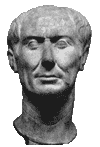
An unflattering portrait of Caesar found near Tusculum, carved during Caesar's own lifetime. Later portraits invariably showed Caesar wearing a laurel crown – to hide his receding hairline.
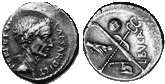 Julius Caesar on denarius from February/March, 44 BC.
Caesar is proclaimed 'perpetual dictator' at the age of 55.
On the reverse of the coin the symbols represent various aspects of Caesar's power and political program.
Fantasy Meets Reality
"... more evidence for the existence of Jesus than there is for anyone else ..."
Let's remind ourselves: Jesus Christ The Legend did some pretty remarkable things. His 'ministry' was a pretty public affair. Many of his tricks were of no particular value (cursing a fig tree?); some would have had disastrous consequences for innocent third parties (remember that herd of 2000 suicidal pigs into which he cast demons? Surely that ruined somebody else's living?).
But certainly, by such 'miracles' he convinced his disciples and the multitude that he was the Messiah, right? Turning a jug of water into wine may have been trivial but resurrecting oneself from death was no mean trick.
But if we are to 'believe' that these stories relate real events what is to be our criteria for acceptance? On what basis should we accept any of this as 'fact' rather than fancy?
A complete record of all the things Jesus never said, all the places he never walked, and all the miracles he never worked.
"No Evidence of Non-existence" – Welcome to the Twilight Zone
In an oddly distorted, negative universe Christian apologists declare that there is "no evidence" for their godman's non-existence, as if it should be quite natural to believe in the most fantastic, illogical and unsubstantiated claims unless there was evidence to the contrary. If this stance had any viability, why stop at Jesus? Why not believe in Zeus, leprechauns and the tooth fairy?
A favourite tack of the Saved is to affect a yawn, mutter "that old stuff again" and impatiently declare that Jesus's non-existence is a 19th century rationalist's heresy long since disposed of by "solid evidence".
The ringing claim of "more evidence for the existence of Jesus than there is for any other person of his day" is followed by a potpourri of ancient sources, as if a list made long enough could disguise the fact that NOT A SINGLE SOURCE EVER QUOTED IS FROM THE TIME OF THE GODMAN.
Early non-Christian writers, including the favourite hostages – Josephus, Suetonius, Pliny and Tacitus – are discussed here.
But stepping around the smokescreen thrown up by evidence that early Christians certainly existed (and had a motley assortment of beliefs!), is the evidence for many of history's greatest heroes and villains really so tenuous?
In His Own Words
Caesar was an eyewitness to many of the events he describes in his commentaries. He wrote not for posterity but to have an immediate impact on the power players in Rome as he schemed to advance his own career.
The elapsed time between the wars and Caesar's own writing was a matter of months or at most a few years.
In contrast, the elapsed time between the gospel reports and the supposed events that they describe is at least 40 years for 'Mark' and 60-70 years for the other three Gospels.
And just who was witness to that fabulous nativity, 30-odd years before the grande finale?
At the most generous understanding, 'Luke' and 'Matthew' were recording hearsay testimony a century after angels, shepherds and wise men went calling.
The unembellished truth is that the gospel accounts were written by eyewitnesses to nothing but their own skills of fabrication.
For good reason, based on spatial and temporal proximity alone, historians give more credence to Caesar's commentaries than to the gospels, no matter how prolifically they were copied.
Contemporary Witnesses to Caesar
Cicero
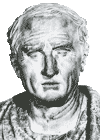
Orations and Letters provide eyewitness evidence of Caesar
Marcus Tullius Cicero (106-43 BC) was almost an exact contemporary of Julius Caesar.
In Caesar's struggle with Pompey, Cicero, governor of Cilicia, sided with Pompey but was subsequently pardoned by Caesar.
In March of 44 BC Cicero was a witness to Caesar's murder, though he was not a part of the conspiracy.
Following the assassination, Cicero made a series of speeches known as the "Philippics" which called on the Senate to support Octavian against Mark Antony. Cicero's "Second Phillipics" was an eulogy of Caesar's conquest of Gaul.
Unfortunately for Cicero Octavian reached a temporary rapprochement with Antony, who then ordered Cicero's murder.
Among some 900 preserved letters to and from Cicero are correspondence both about and with Caesar."... if Caesar does lose his head all the same, Pompey feels only the deepest contempt for him, trusting in his own and the state's troops ..."
– Cicero to Atticus, 7.8, 50BC.
Sallust
Caius Sallust (86-34 BC) tribune, provincial governor and supporter of Caesar. His testimony is in a history "Bellum Catalinae".
Nepos
Cornelius Nepos (c100-24): "Life of Atticus".
Catullus
Gaius Valerius Catullus (c84-54 BC): "Carmina".
Asinius Pollio
Gaius Asinius Pollio (76 BC-4 AD) was an ally of Caesar and founder of the first public library in Rome. He was a source used by Plutarch.
Virgil
Virgil (70BC-17AD): "Aeneid".
Ovid
Ovidius Naso (43BC-17AD): "Metamorphoses".
Near Contemporary Witnesses
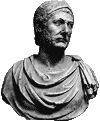
Paterculus
Velleius Paterculus (c19 BC-32 AD): "Historiae Romanae".
Lucan
Lucan (Marcus Annaeus Lucanus, 39-65 AD) followed the example of his grandfather, Seneca the Elder – a young contemporary of Caesar – who in later life wrote a history of Rome.
Lucan wrote his own Pharsalia approximately a century after the civil war it chronicles, using Seneca's work as an eye-witness source.
Plutarch
Plutarch of Chaeronea (45-120 AD) was a Greek moralist, historian and biographer (and priest of Delphi). He wrote his Parallel Lives (matching Greek with Roman lives) during the reigns of Trajan and Hadrian. He describes in detail the life and assassination of Julius Caesar (as well as Marcus Brutus and Mark Antony).
Appian
Appian of Alexandria (c.95-165 AD): Civil Wars.
Suetonius
The most famous biographer of Caesar, Tranquillus Suetonius, wrote his Lives of the Twelve Caesars during the reign of emperor Hadrian (117-138).
Suetonius was in charge of the imperial archives and in this capacity, had access to some of the best possible information.
Et tu Jesus?
There is nothing intrinsically improbable in a radical 1st century rabbi called Jesus. And any figure who emerged as a sage or soothsayer in ancient Palestine is unlikely to have left much evidence of his existence.
But whilst we might entertain, perhaps, a few epithets of reported wisdom from such a guru, it would remain extremely doubtful that any attributed words were actually spoken by him, whatever the claims made today for "oral transmission."
Thus, for example, we can accept the report from Josephus (our only source) that a Jesus ben Ananias caused disquiet in Jerusalem with a non-stop doom-laden mantra of ‘woe to the city’ but suspect that Josephus is using poetic licence when he reports this particular Jesus as saying, "A voice from the east, a voice from the west, a voice from the four winds, a voice against Jerusalem and the holy house, a voice against the bridegrooms and the brides, and a voice against the whole people." (Josephus, Wars 6:3).
Bearing in mind that ancient languages had no symbol for quotation marks and made no distinction between a verbatim account of someone's speech and an accurate paraphrase, Josephus may well be providing a close paraphrase. He was present in Jerusalem at the time (62AD) and wrote his history within about a decade of the event.
Not only was Josephus an eyewitness to much of the drama he described but also had access to Roman imperial archives and military commentaries, the hupomnemata. Josephus can also be checked against archaeological data, and, notwithstanding the occasional exaggeration, what he writes is generally confirmed.
A Fake Witness
As it happens, we have an inordinate amount of Jesus dialogue. Nothing particularly novel or unique is put into his mouth, though much of it is contradictory or obscure. None of it comes from a reliable source.
The Gospel of Thomas (found in a Coptic translation at Nag Hammadi and in Greek fragments at Oxyrhynchus), for example, presents 114 "secret" sayings of Jesus, many of which are rephrased quotations from Jewish scripture and over half resemble dialogue which turns up in the New Testament. Others are simply silly:
"Saying 7: Jesus says: 'Blessed is the lion which a man eats so that the lion becomes a man. But cursed is the man whom a lion eats so that the man becomes a lion!'"Regular Christians, of course, are not very happy with the "5th Gospel" and cast doubt on its "reliability." The sayings are not (yet?) embedded in narrative stories to give them a semblance of historical reality and no miracles are mentioned. "Fake teachings, invented by the Gnostics" is the cry.
"Saying 114: Simon Peter said to them, "Let Mary leave us, for women are not worthy of life." Jesus said, "I myself shall lead her in order to make her male, so that she too may become a living spirit resembling you males. For every woman who will make herself male will enter the kingdom of heaven."
But does wrapping epithets of folk wisdom into a series of "incidents" and "encounters" – even with a miracle thrown in for good measure – make a fraud any less a fraud? Jesus supposedly spoke in Aramaic but the gospels were written in Greek. Literal translation from one language to another inevitably breaks down at numerous points. Not surprisingly the scholars of the Jesus Seminar dismissed more than eighty per cent of the godman's words as invention.
Who Says?
Who would have noted anything "Jesus of Nazareth" said before he emerged as a bona fide spiritual leader? Yet Luke (2.48,49) quotes the godman at the age of 12 in the "temple incident".
Ok, so let's grant that after her son made the big time Mary becomes the proud mum, full of anecdotes about her illustrious offspring ... Maybe she even reminisced about traipsing off to Bethlehem, even Egypt.
But Mary isn't everywhere. Matthew 3 reports dialogue between the godman and John the Baptist (let alone a voice from heaven!) in the wilderness of Judaea. Only when the Baptist gets imprisoned does JC choose his disciples so they wouldn't have been present either. So where does this little story originate, other than in the fertile mind of the gospel writer?
Ok, let's concede "unknown and unstated bystanders" run off to tell the tale ... In fact, we have to rely on such hearsay again and again: JC's night time chat with Nicodemus, his conversation with a Samaritan woman, when his disciples are off shopping, etc., etc.
But we're still not out of the woods. On several occasions the gospel writers quite specifically report Jesus’ conversations when neither they nor any other humans were present.
Who would have had the faintest idea of what Jesus said when he was on his own? For example, chapter 17 of the Gospel of John is entirely taken up with a monologue addressed by a solitary Jesus to God himself.
Matthew (4.3,10) tells of JC in the wilderness and having conversations with Satan.
Now how would Matthew know what was said? Are we to imagine Jesus reminisced, "Hey guys, one time I was in the wilderness for 40 days and 40 nights and guess who showed up ... ?"
If we take this step we may as well dream up the whole nine yards ...
Write your own Jesus Lore!
The gospels provide detailed "Jesus action" for the last year or so of his life but are deafeningly silent about the other 30-odd years. 90% of the godman's biography is missing.
No problem! Taking a lead from Holy Mother Church, creative religious fraudsters have had a grand time colouring in the missing years.
If you like, Jesus travelled with Joseph of Arimathea to Britain to learn druidic lore at Glastonbury. He even built a hut with his own hands.
Or if you prefer, our hero went off to India to spend 17 years as both a student and teacher of Buddhist and Hindu holy men. They affectionately called him Issa.
Other options involve Tibet, Japan and, if you're a Mormon, America.
Why not have Jesus visit your own home town?
In days of lore, a man who never existed can not only be anything, he can be anywhere!

Jesus tomb – Shingo, northern Honshu, Japan.

Jesus tomb – Srinagar, western Kashmir.
Fraud of Ages
Does anyone stand to gain by maintaining a myth? But of course, a vast global industry of religion. Was this always the case? Why YES, unquestionably after Constantine made Christianity the State religion, but no less so in the preceding centuries. Indeed, priests, shamans, witchdoctors have lived on the backs of others since people started living in groups. Given this venal motive of the "religiously inclined", we would be wise to exercise caution before buying its product and accepting its claims.
In those 2000 years did the Church ever fabricate legends and relics?
The vast Medieval forgery industry is a matter of historical record – a contributory cause of the Reformation. Before the canon of holy books was finalized in the 5th century hundreds of fanciful Jesus stories existed. Rancorous Church Councils decided which were 'sacred' and which were 'pious romances.'
Do the claims for Jesus include the suspension of the laws of physics?
Absolutely. We are not talking of a mere carpenter but a worker of miracles. Setting aside the miasma of "Faith" we require rather more evidence for a miracle than a normal activity, not less.
Yet every purported evidence for Jesus turns out to be dubious or non-existent. This includes no contemporary record of Jesus; no evidence for Nazareth in the 1st century; tampered works of non-Christian writers to insert 'evidence'; testimony of early Christians who didn't believe in a human Jesus anyway; gospels which flatly contradict each other; myriad instances of 'Jesus stories' copied from earlier legends and other cultures; and so on and so on.
We have both a motive for Christian fabrication of a myth and the evidence of centuries of myth creation. In other words, what we find "in the beginning" is the same venality and charlatanism that followed, century after century, in each becoming more vicious and ruthless.Leave a comment:
-
Re: If we came from monkeys, why don't we have tails?
"an ancestor"? Look son, no matter how hairy your palms get or how bad your eyesight becomes, it's going to take 2 to tango - you'll learn that as you grow up.Originally posted by Schopenhauer View PostHomos don't breed; they can't.into homo sapiens.Are you suggesting a Bathfire diddled a monkey?monkeys evolved from that ancester into monkeys too. So we evolved parallel.
I suggest that unless the "skeletts" were found engaging in sexual congress, they will provide no proof at all!This can be proven by skeletts which show the evolution from our ancester into homo sapiens sapiensLeave a comment:
-
Re: If we came from monkeys, why don't we have tails?
Nothing in the bible is scientifically proven. Aside from the fact Jerusalem exists.
There are more evidences that Jesus exists than there are for the existence of Caesar
Out of that, evolutionists only think that the mankind evolved by natural und sexual selektion. Thats evolution
We (I say we because I'm an evolutionist too) think that there was an ancestor from whom we evolved into homo sapiens. monkeys evolved from that ancester into monkeys too. So we evolved parallel.
This can be proven by skeletts which show the evolution from our ancester into homo sapiens sapiensLeave a comment:
-
Re: If we came from monkeys, why don't we have tails?
Hello my dear you and I know we evolved from primates, not monkeys. There is some confusion here about that particular point.Originally posted by Alopaner View Post
At any rate if I were you I would go and write up a short introduction, tell us what schools you have attended, and how many science and mathematics classes.Leave a comment:
-
Re: If we came from monkeys, why don't we have tails?
Yeah, a monkey.Originally posted by Alopaner View PostLeave a comment:
-
Re: If we came from monkeys, why don't we have tails?
Hello, this is my first post here. I have yet to get to know the community well enough but here is what I have to say:
Evolutionists don't claim that we evolved from monkeys, but that apes and humans once shared a common ancestor.
Just thought I'd clarify that bit. Also, most apes don't have tails.Leave a comment:
-
Re: If we came from monkeys, why don't we have tails?
BWAHAHAHAOriginally posted by michele View Post You are by far one of the most ignorant excuses for a human being I have ever encountered. Everything in the Bible is 100% true. Everyone with an IQ over 70 knows that.

Another striking evidence of divine inspiration is found in the fact that many of the principles of modern science were recorded as facts of nature in the Bible long before scientist confirmed them experimentally. A sampling of these would include:- Roundness of the earth (Isaiah 40:22)
- Almost infinite extent of the sidereal universe (Isaiah 55:9)
- Law of conservation of mass and energy (II Peter 3:7)
- Hydrologic cycle (Ecclesiastes 1:7)
- Vast number of stars (Jeremiah 33:22)
- Law of increasing entropy (Psalm 102:25-27)
- Paramount importance of blood in life processes (Leviticus 17:11)
- Atmospheric circulation (Ecclesiastes 1:6)
- Gravitational field (Job 26:7)
- and many others.
It is significant also that no real mistake has ever been demonstrated in the Bible—in science, in history, or in any other subject. Many have been claimed, of course, but conservative Bible scholars have always been able to work out reasonable solutions to all such problems.Leave a comment:


Leave a comment: