
 Tweet
Tweet
As a True Christian steward of God’s Creation, I recycle many old banknotes into holes in the ground by investing in fracking companies that do not operate on or near my property. I do this by buying as prices drop on bad news and selling as they rise on (i) good news, (ii) on increased demand for oil and (iii) manufactured shortages of oil: we all like good news.
Another way to recycle is to sell of surplus or worn-out goods to the poor. The wise True Christian will have registered all his assets as company assets and be able to off-set their depreciation against tax. Most of this depreciation is not real, merely calculated to a formula. This enables you to sell the item to yourself, you, personally, sell it on and make a profit.
It seems to me that the poor like mending things, do not have any desire to own “the latest thing” and believe that they are saving landfill – to do this they often are willing to pay way above the market price. (As an observation, it I hard to understand the attitude of the poor – everything ends up in landfill -> it’s just a question of time.)
Many of our readers will be involved in the food business, and this creates a difficulty when it comes to selling surplus food. One suggestion that we can dismiss is “food banks”. Simply put, the poor are not going to buy it if they can get it for free. The Law of Supply and Demand still works and excess food will drive down the profits on food generally.
The “Green” solution here, if you are a manufacturer, is to create retail company franchises to sell the food in areas infested by the poor and where the “real” public will not go because of fears for personal safety. (We also note that the poor are less likely to sue if illness occurs and usually die before a case can be brought to court as they cannot afford medical treatment.)
If there is food that is really so degraded or contaminated that it cannot be sold to the poor because of the likelihood of Federal or State law officers, then the “Green” solution is to form an alliance with a producer to sell out of date stock as pig feed or pet food.
Of course, the more comfortable True Christian will obey the laws of the land and may consider buying tracts of desert for pennies per acre and creating a landfill site. There are regulations on this, but nothing that your lawyers will not be able to stroll through successfully. Those same lawyers will have already prepared a contract that gives your defense prior to purchase, so if there is a leakage of something vile into a water supply, then you will be in the clear and the seller will be found responsible: i.e. you will have been “green.”
On a broader view, servants and other employees can be both recycled and reduce waste. If there is no easy way of dismissing them, I suggest allowing one of your companies to go into bankruptcy in a way that can be managed so that it will leave you with a profit but without employees – these employees can then be recycled into the new company (owned by you) that takes over, however, wages will be lower thus the employees will be buying less and thus disposing of less.
Some whining liberals will find the above a little cynical, but it is important to remember that recycling is important and Jesus said that the poor will always be with us. Thus trying to prevent poverty is pointless. On top of that, the poor can always be informed that, in America, all the methods above are available to them as a way of becoming rich – they just need the get up and go that they have so far lacked. They thus see you as a hero to be emulated, and this means emulating your green policies.
It is the least we can do to help give leadership to the stewardship God has given us.
Another way to recycle is to sell of surplus or worn-out goods to the poor. The wise True Christian will have registered all his assets as company assets and be able to off-set their depreciation against tax. Most of this depreciation is not real, merely calculated to a formula. This enables you to sell the item to yourself, you, personally, sell it on and make a profit.
It seems to me that the poor like mending things, do not have any desire to own “the latest thing” and believe that they are saving landfill – to do this they often are willing to pay way above the market price. (As an observation, it I hard to understand the attitude of the poor – everything ends up in landfill -> it’s just a question of time.)
Many of our readers will be involved in the food business, and this creates a difficulty when it comes to selling surplus food. One suggestion that we can dismiss is “food banks”. Simply put, the poor are not going to buy it if they can get it for free. The Law of Supply and Demand still works and excess food will drive down the profits on food generally.
The “Green” solution here, if you are a manufacturer, is to create retail company franchises to sell the food in areas infested by the poor and where the “real” public will not go because of fears for personal safety. (We also note that the poor are less likely to sue if illness occurs and usually die before a case can be brought to court as they cannot afford medical treatment.)
If there is food that is really so degraded or contaminated that it cannot be sold to the poor because of the likelihood of Federal or State law officers, then the “Green” solution is to form an alliance with a producer to sell out of date stock as pig feed or pet food.
Of course, the more comfortable True Christian will obey the laws of the land and may consider buying tracts of desert for pennies per acre and creating a landfill site. There are regulations on this, but nothing that your lawyers will not be able to stroll through successfully. Those same lawyers will have already prepared a contract that gives your defense prior to purchase, so if there is a leakage of something vile into a water supply, then you will be in the clear and the seller will be found responsible: i.e. you will have been “green.”
On a broader view, servants and other employees can be both recycled and reduce waste. If there is no easy way of dismissing them, I suggest allowing one of your companies to go into bankruptcy in a way that can be managed so that it will leave you with a profit but without employees – these employees can then be recycled into the new company (owned by you) that takes over, however, wages will be lower thus the employees will be buying less and thus disposing of less.
Some whining liberals will find the above a little cynical, but it is important to remember that recycling is important and Jesus said that the poor will always be with us. Thus trying to prevent poverty is pointless. On top of that, the poor can always be informed that, in America, all the methods above are available to them as a way of becoming rich – they just need the get up and go that they have so far lacked. They thus see you as a hero to be emulated, and this means emulating your green policies.
It is the least we can do to help give leadership to the stewardship God has given us.


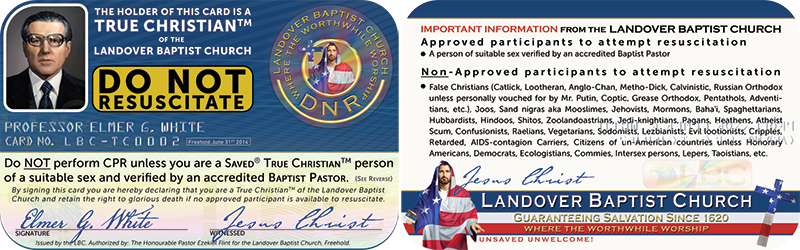



 You can´t go more green than that!


Comment