
 Tweet
Tweet
 Book Report: God in the White House
This is a good book to read if you care about the leader of our country and his beliefs and faith. The author shows how important faith is in choosing a president, and how an Atheist can never become president (you have to read to find out why!).
We didn't really need another book to show us why God is so important, but it doesn't hurt.
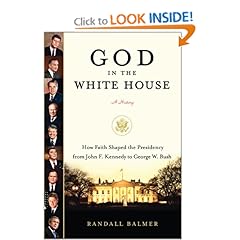
God in the White House: A History: How Faith Shaped the Presidency from John F. Kennedy to George W. Bush (Hardcover)
by Randall Balmer (Author)

 (8 customer reviews)
"This book aspires to answer a relatively simple question: How did we get from John F. Kennedy's eloquent speech at the Rice Hotel in Houston on September 12, 1960, in which he urged voters effectively to bracket a candidate's faith out of their considerations when they entered the voting booth, to George W. Bush's declaration on the eve of the 2000 Iowa precinct caucuses that Jesus was his favorite philosopher? Americans were content to disregard religion as a criterion for voting in 1960, whereas by 2004 they had come to expect candidates fully to disclose their religious beliefs and to expound on their personal relationship to the Almighty. This book attempts to trace that transition."
"If we insist on regarding ourselves as a religious people, if we persist in making claims for our nation's moral superiority, then we must hold ourselves and our nation accountable to the values we espouse. Otherwise, we should drop all pretense of piety, political or otherwise. If we want to view ourselves as a religios people, however, it's not sufficient merely to allow politicians to function as the vicarious projections of our faith. We have to engage in the arduous work of living up to our professed ideals, both individually and collectively. Anything less is cheap grace."
We didn't really need another book to show us why God is so important, but it doesn't hurt.
God in the White House: A History: How Faith Shaped the Presidency from John F. Kennedy to George W. Bush (Hardcover)
by Randall Balmer (Author)
(8 customer reviews)"This book aspires to answer a relatively simple question: How did we get from John F. Kennedy's eloquent speech at the Rice Hotel in Houston on September 12, 1960, in which he urged voters effectively to bracket a candidate's faith out of their considerations when they entered the voting booth, to George W. Bush's declaration on the eve of the 2000 Iowa precinct caucuses that Jesus was his favorite philosopher? Americans were content to disregard religion as a criterion for voting in 1960, whereas by 2004 they had come to expect candidates fully to disclose their religious beliefs and to expound on their personal relationship to the Almighty. This book attempts to trace that transition."
"If we insist on regarding ourselves as a religious people, if we persist in making claims for our nation's moral superiority, then we must hold ourselves and our nation accountable to the values we espouse. Otherwise, we should drop all pretense of piety, political or otherwise. If we want to view ourselves as a religios people, however, it's not sufficient merely to allow politicians to function as the vicarious projections of our faith. We have to engage in the arduous work of living up to our professed ideals, both individually and collectively. Anything less is cheap grace."



Comment