
 Tweet
Tweet
Hey all. As part of my on-going mission to convert the people of Landover into the one true faith, Roman Catholicism, I am making this thread to highlight all of the great Saints in our church's history. I'll try to update this regularly.
Today, I will show some of my favorite female saints.
St. Christina

Saint Christina is a martyr who lived during the 3rd century BC. St. Christina was brought up in the coastal City of Tyre, modern Lebanon. The accounts of her early life reveal her father to be a wealthy and a cruel man who had tortured her because of her belief in Christianity. Christina was a beautiful child full of love and affection. It is believed God revealed Himself to her through an angel. Urbain, her father became her persecutor. He tore her body with iron hooks and tied her to a rack beneath which a fire was kindled. Christina’s faith in God saved her. God turned the flames on the bystanders. Urbain had two successors, Dion and Julian. Dion died an unexpected death, after he threw her into a burning furnace. She remained in the furnace unhurt for five days. In another incident, a stone was tied around her neck and she was thrown into the lake of Balsena. However, God’s angel saved her again, and her father died after this incident. Saint Christina was thrown into a cage of serpents. But Christ saved her once again.
Julian was her last persecutor; he cut off St. Christina’s tongue and her breast. Saint Christina attained her martyr’s crown at the city of Tyre and her own blood baptized her. By this time many of the pagans of Tyre were inspired to follow her faith. Her relics rest at Palermo in Sicily.
St. Agatha
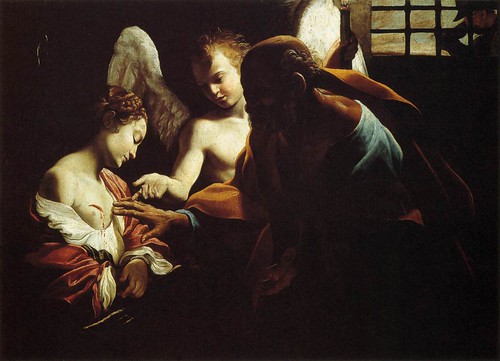
Saint Agatha of Sicily (died traditionally 251) is a Christian saint. Agatha was born at Catania, Sicily, and she was martyred in approximately 251. According to Jacobus de Voragine, Legenda Aurea of ca. 1288, having dedicated her virginity to God, Agatha, rich and noble rejected the amorous advances of the low-born Roman prefect, Quintianus; she was persecuted by him for her Christian faith.
Among the tortures she underwent was the cutting off of her breasts. An apparition of Saint Peter cured her. After further dramatic confrontations with Quintianus, represented in a sequence of dialogues in her passio that document her fortitude and steadfast devotion, her scorned admirer eventually sentenced her to death by being rolled naked on a bed of live coals, "and anon the ground where the holy virgin was rolled on, began to tremble like an earthquake, and a part of the wall fell down upon Silvain, counsellor of Quintianus, and upon Fastion his friend, by whose counsel she had been so tormented." Saint Agatha died in prison, according to the Legenda Aurea in "the year of our Lord two hundred and fifty-three in the time of Decius, the emperor of Rome." She is the patron saint of Catania, Molise, and San Marino, and of Malta, because her intercession is reported to have saved Malta from Turkish invasion in 1551.
St. Febronia
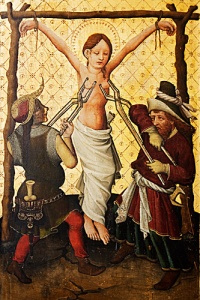
Beautiful nun at Nisibis, Mesopotamia. During the persecution of Diocletian, she was arrested for her faith. She was offered freedom if she would renounce Christianity, marry Diocletian's nephew Lysimachus, and stop him from joining the Church; she declined. Tortured, mutilated and murdered. Lysimachus, who had been leaning toward Christianity to begin with, converted along with many of the witnesses to Febronia's abuse; the judge, Selenus, went insane and killed himself. This story became immensely popular, and in some of the re-tellings the tortures were described in ghastly detail. Born: 3rd century. Died: martyred in 304.
Representation : holding a palm of martyrdom and the shears used to cut off her breasts
St. Tatiana

The Holy Virgin Martyr Tatiana was born into an illustrious Roman family, and her father was elected consul three times. She was made a deaconess in one of the Roman churches and served God in fasting and prayer, tending the sick and helping the needy. Tatiana was arrested and was brought into the temple of Apollo and forced to offer sacrifice to the idols. The saint began to pray, and suddenly there was an earthquake. The idols were smashed into pieces, and part of the temple collapsed and fell down on the pagan priests. The demon inhabiting the idols fled screeching from the temple. Those present saw its shadow flying through the air. The pagans then tore the holy virgin’s eyes out with hooks, but she bravely endured everything, praying for her tormentors that the Lord would open their spiritual eyes. The Lord heard the prayer of His servant. The executioners saw four angels encircle the saint and beat her tormentors. A voice was heard from the heavens speaking to the holy virgin. Eight men believed in Christ and fell on their knees before St. Tatiana, begging her to forgive them their sins. The next day, St. Tatiana was brought before the judge. Seeing her completely healed of all her wounds, she was stripped and beaten, and her body was slashed with razors. A wondrous fragrance filled the air. The torturers became exhausted and said that an invisible power was beating them with iron rods. Indeed, the angels warded off the blows directed at her and turned them upon the tormentors, causing nine of them to fall dead. They then threw Tatiana in prison, where she prayed all night and sang praises to the Lord with the angels. A new morning began, and St. Tatiana was taken to the tribunal once more. The torturers beheld with astonishment that after such terrible torments she appeared completely healthy and even more radiant and beautiful than before. They began to urge her to offer sacrifice to the goddess Diana. The saint seemed agreeable, and they took her to the heathen temple. St. Tatiana made the Sign of the Cross and began to pray. Suddenly, there was a crash of deafening thunder, and lightning struck the idol, the sacrificial offerings and the pagan priests. Once again, the martyr was fiercely tortured.
She was hung up and scraped with iron claws, and her breasts were cut off. That night, angels appeared to her in prison and healed her wounds as before. On the following day, they took St. Tatiana to the circus and loosed a hungry lion on her. The beast did not harm the saint, but meekly licked her feet. As they were taking the lion back to its cage, it killed one of the torturers. They threw Tatiana into a fire, but the flames did not harm her. The pagans, thinking that she was a sorceress, cut off her hair to take away her magical powers, then locked her up in the temple of Zeus. On the third day, pagan priests came to the temple intending to offer sacrifice to Zeus. They beheld the idol on the floor, shattered to pieces, and the holy martyr Tatiana joyously praising the Lord Jesus Christ. The judge then condemned her to be beheaded with a sword. Her father was also executed with her, because he had raised her to love Christ.
St. Giulia

Giulia was a young slave who was forced to leave Corsica to go to Carthage where she was to be sold. However, at the ships edge, she refused to go and was beaten, crucified and mutilated.
Her torturers threw her breasts onto a rock and miraculously two rivers began to flow. Today there is also a small church at this beach which was dedicated Giulia, who is now a martyr.
St. Barbara


During the rule of Maximius, in the year 290 AD, the governor in the Anatolian city of Heliopolis was Dioscuros. He was a wealthy man who was originally from the nearby village of Galassos. He had only one child, a very beautiful girl named Barbara. Her parents were extremely proud of her, not only because of her beauty, but of her virtuosity as well. To protect her, her parents erected a fortress in which they placed Barbara while still young, as was the case with Saint Christina. When Barbara came of age, many military officers of Heliopolis asked her father for her hand in marriage, for they had heard of her great beauty and charm. He refused, however, to give his promise to anyone until he conferred with his daughter. Barbara responded by telling her father that if he forced her to marry she would commit suicide. Dioscuros, deciding to add a bathing house to the fortress, left the plans with the builders and instructed them to begin work while he departed for another city where he had some pressing business. During her father's absence, Barbara had the opportunity to leave her living quarters and observe the erection of the bathing house. Upon discovering that the building was to have only two windows, she asked the builders to install a third, and that she would assume the responsibility. Our God, who knows everything before it occurs, was extremely pleased with Barbara's innocence and filled her heart with the Holy Spirit and with the love of Christ. While standing by the pool of the bath house, Barbara made the sign of the cross on the marble with her finger. Miraculously, her finger chiselled the cross deeply into the marble. One day, returning from the bath house, Barbara noticed the false gods which her father worshipped and she spat at them. She returned to the fortress, fasting and praying that she would receive Divine Guidance. When her father returned, he saw the third window in the bath house and questioned the builders, who informed him that his daughter had ordered the third window installed. After questioning Barbara whether there was any particular reason for three, she told him that Three Lights guide everyone who walks the earth. Making the sign of the cross with three fingers she said that one signifies the Father, one the Son, and the other the Holy Spirit, and with these three Lights the whole world is guided. Drawing his sword and threatening to kill her, Barbara fled to a nearby mountain. Reaching the top, she raised her arms and prayed to God for help. The earth parted and swallowed most of her body. Finding his daughter, Dioscuros forced her back to the fortress and locked her up. He then went to the ruler of the city named Marcius and informed him that Barbara was a Christian. She was then given to Marcius with her father's damnation. Marcius had the Saint stripped and beaten with sticks, then her wounds rubbed with vinegar. She was then imprisoned. Towards midnight a bright light appeared to Barbara and a voice told her not to fear, Christ was always with her. As soon as the words were spoken, all her wounds disappeared. A God-fearing woman, named Julia, who was imprisoned with Barbara, saw the miracle. The tortures continued for Barbara. The ruler ordered his soldiers to tear the Saint's body with iron claws, to burn her with torches and to hit her head with a spiked club.
He then had his soldiers cut off the martyr's breasts then taken back to prison. St. Barbara was stripped of her clothing to be marched throughout the city. Seeing though that he could not overcome the Saint with threats and tortures, Marcius ordered his soldiers to behead both Barbara and Julia. Barbara and Julia were taken to the mountain where Dioscuros had previously captured his daughter. He beheaded St. Barbara and a soldier beheaded St. Julia. For several seconds the earth shook. The earth then opened and swallowed the bodies of the two martyrs. God was quick with Divine Retribution to Dioscuros, for as he was descending the mountain, a thunder storm arose. A bolt of lightning descended from the heavens and killed this bloodthirsty tyrant. A second bold of lightning immediately descended and murdered St. Julia's executioner. After several days, a pious Christian named Valentios saw in his dream two white robed virgins who instructed him to go to the mountain on which the Saints had been executed and to dig to find their bodies. Valentios immediately arose from his bed and with several other Christians, went to the mountain to carry out the Saint's instructions. After digging for several hours, they found the holy bodies of Sts Barbara and Julia. With great respect and reverence, they venerated the bodies of the Saints.
See also: St. Anastasia and St. Juliana, who had remarkably similar stories. Great saints live alike, I guess.
Today, I will show some of my favorite female saints.
St. Christina

Saint Christina is a martyr who lived during the 3rd century BC. St. Christina was brought up in the coastal City of Tyre, modern Lebanon. The accounts of her early life reveal her father to be a wealthy and a cruel man who had tortured her because of her belief in Christianity. Christina was a beautiful child full of love and affection. It is believed God revealed Himself to her through an angel. Urbain, her father became her persecutor. He tore her body with iron hooks and tied her to a rack beneath which a fire was kindled. Christina’s faith in God saved her. God turned the flames on the bystanders. Urbain had two successors, Dion and Julian. Dion died an unexpected death, after he threw her into a burning furnace. She remained in the furnace unhurt for five days. In another incident, a stone was tied around her neck and she was thrown into the lake of Balsena. However, God’s angel saved her again, and her father died after this incident. Saint Christina was thrown into a cage of serpents. But Christ saved her once again.
Julian was her last persecutor; he cut off St. Christina’s tongue and her breast. Saint Christina attained her martyr’s crown at the city of Tyre and her own blood baptized her. By this time many of the pagans of Tyre were inspired to follow her faith. Her relics rest at Palermo in Sicily.
St. Agatha
Saint Agatha of Sicily (died traditionally 251) is a Christian saint. Agatha was born at Catania, Sicily, and she was martyred in approximately 251. According to Jacobus de Voragine, Legenda Aurea of ca. 1288, having dedicated her virginity to God, Agatha, rich and noble rejected the amorous advances of the low-born Roman prefect, Quintianus; she was persecuted by him for her Christian faith.
Among the tortures she underwent was the cutting off of her breasts. An apparition of Saint Peter cured her. After further dramatic confrontations with Quintianus, represented in a sequence of dialogues in her passio that document her fortitude and steadfast devotion, her scorned admirer eventually sentenced her to death by being rolled naked on a bed of live coals, "and anon the ground where the holy virgin was rolled on, began to tremble like an earthquake, and a part of the wall fell down upon Silvain, counsellor of Quintianus, and upon Fastion his friend, by whose counsel she had been so tormented." Saint Agatha died in prison, according to the Legenda Aurea in "the year of our Lord two hundred and fifty-three in the time of Decius, the emperor of Rome." She is the patron saint of Catania, Molise, and San Marino, and of Malta, because her intercession is reported to have saved Malta from Turkish invasion in 1551.
St. Febronia
Beautiful nun at Nisibis, Mesopotamia. During the persecution of Diocletian, she was arrested for her faith. She was offered freedom if she would renounce Christianity, marry Diocletian's nephew Lysimachus, and stop him from joining the Church; she declined. Tortured, mutilated and murdered. Lysimachus, who had been leaning toward Christianity to begin with, converted along with many of the witnesses to Febronia's abuse; the judge, Selenus, went insane and killed himself. This story became immensely popular, and in some of the re-tellings the tortures were described in ghastly detail. Born: 3rd century. Died: martyred in 304.
Representation : holding a palm of martyrdom and the shears used to cut off her breasts
St. Tatiana

The Holy Virgin Martyr Tatiana was born into an illustrious Roman family, and her father was elected consul three times. She was made a deaconess in one of the Roman churches and served God in fasting and prayer, tending the sick and helping the needy. Tatiana was arrested and was brought into the temple of Apollo and forced to offer sacrifice to the idols. The saint began to pray, and suddenly there was an earthquake. The idols were smashed into pieces, and part of the temple collapsed and fell down on the pagan priests. The demon inhabiting the idols fled screeching from the temple. Those present saw its shadow flying through the air. The pagans then tore the holy virgin’s eyes out with hooks, but she bravely endured everything, praying for her tormentors that the Lord would open their spiritual eyes. The Lord heard the prayer of His servant. The executioners saw four angels encircle the saint and beat her tormentors. A voice was heard from the heavens speaking to the holy virgin. Eight men believed in Christ and fell on their knees before St. Tatiana, begging her to forgive them their sins. The next day, St. Tatiana was brought before the judge. Seeing her completely healed of all her wounds, she was stripped and beaten, and her body was slashed with razors. A wondrous fragrance filled the air. The torturers became exhausted and said that an invisible power was beating them with iron rods. Indeed, the angels warded off the blows directed at her and turned them upon the tormentors, causing nine of them to fall dead. They then threw Tatiana in prison, where she prayed all night and sang praises to the Lord with the angels. A new morning began, and St. Tatiana was taken to the tribunal once more. The torturers beheld with astonishment that after such terrible torments she appeared completely healthy and even more radiant and beautiful than before. They began to urge her to offer sacrifice to the goddess Diana. The saint seemed agreeable, and they took her to the heathen temple. St. Tatiana made the Sign of the Cross and began to pray. Suddenly, there was a crash of deafening thunder, and lightning struck the idol, the sacrificial offerings and the pagan priests. Once again, the martyr was fiercely tortured.
She was hung up and scraped with iron claws, and her breasts were cut off. That night, angels appeared to her in prison and healed her wounds as before. On the following day, they took St. Tatiana to the circus and loosed a hungry lion on her. The beast did not harm the saint, but meekly licked her feet. As they were taking the lion back to its cage, it killed one of the torturers. They threw Tatiana into a fire, but the flames did not harm her. The pagans, thinking that she was a sorceress, cut off her hair to take away her magical powers, then locked her up in the temple of Zeus. On the third day, pagan priests came to the temple intending to offer sacrifice to Zeus. They beheld the idol on the floor, shattered to pieces, and the holy martyr Tatiana joyously praising the Lord Jesus Christ. The judge then condemned her to be beheaded with a sword. Her father was also executed with her, because he had raised her to love Christ.
St. Giulia
Giulia was a young slave who was forced to leave Corsica to go to Carthage where she was to be sold. However, at the ships edge, she refused to go and was beaten, crucified and mutilated.
Her torturers threw her breasts onto a rock and miraculously two rivers began to flow. Today there is also a small church at this beach which was dedicated Giulia, who is now a martyr.
St. Barbara
During the rule of Maximius, in the year 290 AD, the governor in the Anatolian city of Heliopolis was Dioscuros. He was a wealthy man who was originally from the nearby village of Galassos. He had only one child, a very beautiful girl named Barbara. Her parents were extremely proud of her, not only because of her beauty, but of her virtuosity as well. To protect her, her parents erected a fortress in which they placed Barbara while still young, as was the case with Saint Christina. When Barbara came of age, many military officers of Heliopolis asked her father for her hand in marriage, for they had heard of her great beauty and charm. He refused, however, to give his promise to anyone until he conferred with his daughter. Barbara responded by telling her father that if he forced her to marry she would commit suicide. Dioscuros, deciding to add a bathing house to the fortress, left the plans with the builders and instructed them to begin work while he departed for another city where he had some pressing business. During her father's absence, Barbara had the opportunity to leave her living quarters and observe the erection of the bathing house. Upon discovering that the building was to have only two windows, she asked the builders to install a third, and that she would assume the responsibility. Our God, who knows everything before it occurs, was extremely pleased with Barbara's innocence and filled her heart with the Holy Spirit and with the love of Christ. While standing by the pool of the bath house, Barbara made the sign of the cross on the marble with her finger. Miraculously, her finger chiselled the cross deeply into the marble. One day, returning from the bath house, Barbara noticed the false gods which her father worshipped and she spat at them. She returned to the fortress, fasting and praying that she would receive Divine Guidance. When her father returned, he saw the third window in the bath house and questioned the builders, who informed him that his daughter had ordered the third window installed. After questioning Barbara whether there was any particular reason for three, she told him that Three Lights guide everyone who walks the earth. Making the sign of the cross with three fingers she said that one signifies the Father, one the Son, and the other the Holy Spirit, and with these three Lights the whole world is guided. Drawing his sword and threatening to kill her, Barbara fled to a nearby mountain. Reaching the top, she raised her arms and prayed to God for help. The earth parted and swallowed most of her body. Finding his daughter, Dioscuros forced her back to the fortress and locked her up. He then went to the ruler of the city named Marcius and informed him that Barbara was a Christian. She was then given to Marcius with her father's damnation. Marcius had the Saint stripped and beaten with sticks, then her wounds rubbed with vinegar. She was then imprisoned. Towards midnight a bright light appeared to Barbara and a voice told her not to fear, Christ was always with her. As soon as the words were spoken, all her wounds disappeared. A God-fearing woman, named Julia, who was imprisoned with Barbara, saw the miracle. The tortures continued for Barbara. The ruler ordered his soldiers to tear the Saint's body with iron claws, to burn her with torches and to hit her head with a spiked club.
He then had his soldiers cut off the martyr's breasts then taken back to prison. St. Barbara was stripped of her clothing to be marched throughout the city. Seeing though that he could not overcome the Saint with threats and tortures, Marcius ordered his soldiers to behead both Barbara and Julia. Barbara and Julia were taken to the mountain where Dioscuros had previously captured his daughter. He beheaded St. Barbara and a soldier beheaded St. Julia. For several seconds the earth shook. The earth then opened and swallowed the bodies of the two martyrs. God was quick with Divine Retribution to Dioscuros, for as he was descending the mountain, a thunder storm arose. A bolt of lightning descended from the heavens and killed this bloodthirsty tyrant. A second bold of lightning immediately descended and murdered St. Julia's executioner. After several days, a pious Christian named Valentios saw in his dream two white robed virgins who instructed him to go to the mountain on which the Saints had been executed and to dig to find their bodies. Valentios immediately arose from his bed and with several other Christians, went to the mountain to carry out the Saint's instructions. After digging for several hours, they found the holy bodies of Sts Barbara and Julia. With great respect and reverence, they venerated the bodies of the Saints.
See also: St. Anastasia and St. Juliana, who had remarkably similar stories. Great saints live alike, I guess.





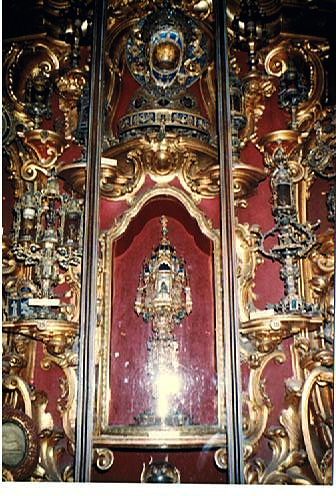 (shrine which holds the saint's tongue)
Comment